Kashrut
History of Kashrut - the history of what is, and what is not, Kosher.
This talk was given on 4th September 2005 at Northwood and Pinner Liberal Synagogue. It was the occasion of the European Day of Jewish Culture and our Synagogue chose to feature Jewish Food. My talk was given to a mixed audience of Jews, Christians and Moslems. Many of the Christians in the audience were particularly interested in learning how the early Christians, who at first followed the Jewish rules about Kashrut, were later permitted to eat non-kosher food.

The literal meaning of kosher (Kasher, in Hebrew) is what is fit and proper. In relation to food it is what one may eat, what one may not eat, and how it must be prepared, in other words - our Dietary Laws. The word Kashrut refers to the rules generally. The strict pronunciation of the word should be kasher, but in the vernacular it is pronounced kosher and that is how I will use it here.
Now, what is this thing called Kosher, or Kasher, or Kashrut? Let's look at it from an historical basis. First what the Bible itself said and then how, over the centuries, the rabbis have interpreted and added to what the Bible had said. Then the modem period, and the views of modem Orthodoxy, the Reform movement and the Liberal movement. And how Kashrut compares with the rules of other religions.
The essentials of Kashrut were first set out in our Torah. It was handed down divinely to the Israelites over 3,000 years ago or, if you prefer, set down about 2,500 years ago by scribes who were divinely inspired or again, if you prefer, by scribes who had social and political aims – many, perhaps, in advance of their times. The Books of the Bible, in particular the Books of Leviticus and Deuteronomy, go into remarkable details about the rules of what may, and what may not, be eaten.
The Bible does not itself use the actual word ''kosher'' or "kasher" in relation to food. The Bible refers to animals that are "clean" or "unclean" originally, probably, with reference to suitability for sacrifice. It was the rabbis who later applied the word Kasher to indicate what food was fit and proper. Over the centuries reasons have been rationalised to explain kashrut, but to an orthodox person no explanation is necessary - it is sufficient that the Bible says so. Basically, the Kashrut rules that Jews apply today are really the rules that were laid down over the centuries by the Rabbis based on their interpretation of the Biblical rules.
But what did the Bible (in particular Genesis, Leviticus and Deuteronomy) actually say? Well, at the very beginning of Genesis, Adam and Eve are told they have been given fruit and vegetables as food and dominion over animals and any can be eaten alone, or together with meat or fish or fowl. As, in Genesis, there was no reference to animals as food, some rabbis have argued that human beings were intended to be vegetarians or even vegans.
Now, what about Animals, Birds and Fish? The Book of Deuteronomy very largely repeats what the Book of Leviticus says so, for simplicity, I will summarise them both together:
Animals: Any animal has both a cloven foot and chews the cud may be eaten. It must have both. If it has only one but not the other it is forbidden. Thus oxen, sheep, goats etc are kosher but pig, which has cloven hoofs but does not chew the cud, is forbidden. (For your information that rule applies also to hippopotamus !) Likewise camels, which chew the cud but do not have cloven hoofs, are forbidden.
Any animal that that died naturally or was killed by another animal, is forbidden. The Bible specifically forbids drinking the blood of any animal on the basis that life is contained in the blood. Certain parts of an animal are also forbidden such as the eating of the "sinew of the thigh” - probably linked to the injury to Jacob's thigh when he struggled with the Angel. Certain fat portions attached to the stomach and intestines (which were used in sacrifices) are forbidden as food, and have to be removed by "porging”
Fish: Fish that have fins and scales, like Carp, Salmon, Trout and Herring are kosher. Crustaceans like crab and lobster are not kosher but Sturgeon and its caviar are borderline cases!
Birds: The Bible lists 24 "Unclean" birds but does not itself explain why they are unclean. Leviticus does however specifically permit certain types of locust to be eaten, (I am told they are delicious).
Mixing Meat and Milk: In the Pentateuch it is stated three times that "thou shalt not seethe (i.e. boil) a kid in its mother's milk". It does not say why. It certainly seems very distasteful to boil a kid in its mother's milk and, as we shall see, the Rabbis extended it to any mixing of meat and milk.
So much for what the Bible itself tells us about these items. Now let us see how the rabbis have interpreted, elaborated, and added to the Biblical rules over the centuries. Basically, the day-to-day application of kashrut that is followed now is what the rabbis have decided - often with conflicting decisions that have created problems for orthodox Jews.
Rabbinical Interpretation:
Meat.
The Bible says what may and what may not be eaten, but it was the rabbis who laid down the rules about how the animals are to be slaughtered and made suitable for supply to the public. These rules are known as "Shechitah". First the animal must be examined to see that it not suffering from any of a large number of medical defects. If it has any defect it is considered "Trefah" and not used. The healthy, kosher, animal is then suspended upside down and its throat is cut with a single, painless cut with a perfectly sharp blade that causes almost instantaneous loss of blood to its brain and painless death within a few seconds. After slaughtering, the animal is left suspended so that as much blood as possible is drained off. Pre-stunning is not allowed. There is, of course, much controversy about which method is the least cruel, and some countries demand pre-stunning and some even forbid Shechita.
Poultry are slaughtered in the same way but there are no special rules about how fish are to be killed.
After the animal is slaughtered there is the "koshering" of the meat, either by the butcher or at home. Basically it is designed to remove any remaining blood, and this is done mainly by salting and broiling. Any remaining parts of the animal that are forbidden as food must be removed. An egg that contains a blood spot may not be eaten - it should be checked before being put in a heated frying pan as it would render the frying pan non-kosher.
Separation of meat and milk.
The Biblical law against seething (boiling) a kid in its mother's milk has been extended and broadened by the Rabbis to endless lengths. It was made to apply to all milk in case the milk that is being used might have been from its mother. Over the centuries in the diaspora, rabbis in various parts of the world have added their own interpretations and there are differences of opinion about many of the details.
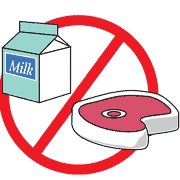
However, the basic rules that have developed forbid the eating of any meat and dairy products together. Some rabbis developed rules about whether meat can be eaten with poultry, or milk with poultry, or meat with fish, and so on, and so on…
Some rabbis require that after eating meat there must be a wait of anything up to six hours before taking dairy products. The reasoning is that fatty particles stick to one's teeth for long periods. However, meat can in principle be eaten right after milk, provided the dairy product is not one that sticks to the teeth and one rinses one's mouth out with water! For those of you who are Biblical scholars, Abraham fed the angels with milk and meat, and Abraham was supposed to know the rules of kashrut. It is pointed out that he fed them the milk first!
In principle, the smallest amount of non-kosher food in the finished food renders it all non-kosher, but in certain circumstances the food is still acceptable. The rules are difficult but basically if it is no more than one-sixtieth non-kosher, it is acceptable. Not only the food but the utensils must be kosher. Meat will "contaminate" utensils used for milk, and vice versa. The rules have become so rigid and complex that some very orthodox homes have, in effect, two separate kitchens.
Items like wine that have been stored together with wine that may have been used in "idolatrous" ritual are non-kosher so, to be safe, orthodox kashrut forbids wines that have been produced by non- Jews. There was recently a serious (or amusing, if you prefer) problem about the human hair used to make married women's wigs or "shaitels". It was discovered that some of the hair came from Hindu women in India and it had been cut off in some Hindu temple ceremony. This caused panic. Wealthy women who had bought expensive human hair wigs had to discard and burn them, while poorer women who had to manage with artificial hair had no problem!
Explanation and Justification of Dietary Laws.
There have been many attempts to explain and justify kashrut on grounds that it makes one more holy, or more moral, or is healthy, or that it purifies the soul. Another explanation is that in reality it was deliberately intended to set those that obey the rules of kashrut apart from other groups. It certainly helps to have that last effect. It is also clear that some rules of kashrut do coincide with some rules of hygiene. It is doubtful whether that was the original intention, and one can argue that some of the circumstances in which kashrut is applied in practice, do not always coincide with modern ideas of hygiene. A too strict obedience to the precise rule, is often used to allow other less desirable practices, including hygienic, to apply.
The Situation Today:
Kashrut has become an industry. Many organisations vie with each other about how they are more kosher than others, and how cheaper certificates from other organisations are not really kosher. Kosher food is consequently more expensive than other food. People who take kashrut very seriously are often in a quandary and have to rely on their local rabbi for advice.
I
Orthodox Judaism in UK, and Conservatism in USA, insist on strict application of the formal traditional rules [but people often make a distinction between keeping kashrut in the home and less strict kashrut outdoors.] About the middle of the 19th century the Reform movement in USA stated that many of the dietary laws of kashrut were based on priestly temple practices and have no application today. The UK Liberal Judaism’s attitude is that the Jewish religion is not a question of eating habits, and accordingly it is left to the individual to decide where he stands on kashrut.
I should like now to describe the main relationship between the dietary laws of the three religions: Christianity, Judaism and Islam.
The early Christians were Jews and followed the Jewish dietary laws. They tried to convert their neighbours but there was a problem. Other Jews, for the most part, were not interested in joining the heretics. At that time the peoples living around the land of Israel were pagans, with mainly Greek Hellenistic traditions. They were ready to adopt a new monotheistic religion and Judaism could have been acceptable to them - if it weren't for this kashrut thing (and also incidentally the circumcision thing). The strictness of the kashrut rules limited drastically what you could eat, and thus who you could eat with, and it accordingly reduced social contact with others. To quote Shakespeare: "I will walk with you, talk with you, but I will not eat with you". The surrounding Hellenists did not like the idea of kashrut at all.
The new Christians, in particular Mark (Gospel of Mark, 7:19) saw the marketing possibilities, and he and Peter (Acts 10:9-15) said it was not necessary to apply the Jewish dietary rules ( and incidentally in Acts 15:19 Peter said it was not necessary to impose the “irksome restriction of circumcision” on converts to Christianity). Thus over the next few centuries it was Christianity and not Judaism that received the converts. And the Christians became less and less concerned with what, from a religious point of view, could or could not be eaten.
About 1,400 years ago the new religion of Islam arose and swept through much of the then known world. To a large extent Islam adopted the theological essentials of Judaism, including their dietary laws of Kashrut. The Moslem equivalent word is Halal. Over the centuries and right up to today the dietary laws of Jews and Moslems have remained remarkably similar - but not identical. In fact if no halal butcher is available Moslems may eat kosher meat.
In Kashrut many animals in addition to the pig are forbidden. The only animal Halal formally forbids is the pig. Eating other animals is permitted (although in different areas some other animals are considered also wrong to eat). There is great similarity in the rules regarding the slaughtering of animals and draining of blood.
The Torah has many strict rules about birds and fish. The Quran says nothing about birds and fish, but birds of prey and crawling sea creatures like crabs and lobsters are considered wrong as food. Insects are generally forbidden but certain locusts are both kosher and halal.
Judaism has no restriction on alcohol (in fact wine plays a part at Shabbat and certain Festivals, as it does in certain Christian ceremonies) but Islam forbids any alcohol.
Kashrut and Halal both condemn any food that has been, or may have been, consecrated to idol worship.
Unlike Judaism, Islam has no rules regarding mixing of foods like meat and milk.
In both Judaism and Islam running water is considered cleaner than still water. This has logic, but in the Middle East in some countries this causes the strange situation of a running stream being considered acceptable to drink, no matter what may be going into the water a short distance upstream.
Most religions have some rules or customs about special food to be eaten on certain holy days and festivals, and Judaism and Islam have detailed rules about fasting at certain times. Some Christians do not eat meat on Fridays or during Lent, but these are more custom than religious rules. It is Judaism and Islam that have the strict religious rules about what may and what may not be eaten.
-oOo-