The Jews of Cochin
(Included in Davar Feb 1991)
"...for as long as the world and moon shall exist".
We wish no harm to the Burmese people but Penny and I were grateful to them last year that the threatened insurrection in their country caused a change in our ship's schedule. Instead of calling at Rangoon we stopped at Cochin on the Malabar coast of SW India. Visiting the remaining Jewish community in Cochin is like entering a theatre just as the curtain is about to come down; the props will remain but the actors will soon disappear.
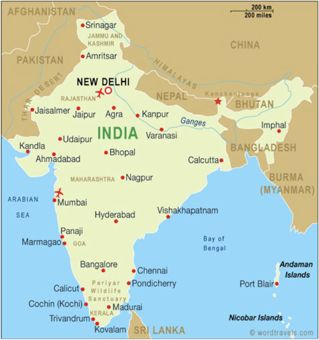
Modern map of India. Cochin's new name is Kochi .
No-one knows when the Jews first arrived in the Cochin area in what is now the State of Kerala. Legend says it was at the time of King Solomon, or at the destruction of the first Temple by Nebuchadnezzar, or during the 1st or 4th century CE etc etc. 22 years ago the “Paradesi" Jews of Cochin celebrated the 1,900th anniversary of the traditional date of the founding of their community, but the earliest written record is an inscription in the ancient Tamil language engraved on two copper plates recording the "charter" granting the Jewish community security and tax privileges ".. .for as long as the world and moon shall exist".It was granted around the year 1, 000 CE by the Hindu ruler Bhaskara Ravi Varma to Joseph Rabban ( known as Issuppu Irappan). The copper plates are still deposited in an iron box in the Paradesi Synagogue.
At the beginning of the 20th century there were in the area around Cochin about 2000 Jews. They had adopted the equivalent of the Hindu caste system. There were "White Jews", also called "Paradesi" (foreigners) who were mainly exiles from Spain and Holland. They followed, in effect, the Sephardi rite. The so-called “Black Jews" have the same colouring as other Indians and had their own synagogues. The third group were the "Meshuhrarim" (Emancipated Slaves) who attached themselves to either community but, until 1932, had no right to be involved in the synagogues (except on Simchat Torah). At the end of the 19th century the Chief Rabbi of Jerusalem ruled that the "Blacks" were true Jews but the Meshuhrarim would be treated as such only after immersion in a mikveh. To the extent that the Cochin community still exists the divisions continue and there has been very little, if any, intermarriage between the groups.
Except during the period of the Portuguese occupation the Hindus, Muslims, Christians and Jews lived harmoniously together. The Jewish community in nearby Goa was wiped out by the Portuguese Inquisition but the Cochin Jews wisely and courageously supported the Dutch who invaded the area. In return the Cochin Jews were granted security and privileges by the grateful Dutch victors. Under the Dutch and the succeeding British Raj the Cochin Jews lived happily and prosperously until 1948. The White Jews inhabited, and still inhabit, the "Jewtown" area of Mattancherry, and the Black and Meshuhrarim Jews inhabit the neighbouring "Jewtown" of Ernakulam. The districts are still known as Jewtown and when asking for directions that is what you ask for.
The advent of the Dutch in the 17th century opened a window on the Western World for the Cochin Jews. Their contacts with Amsterdam brought them new literature on Jewish prayers, customs and history and the output by the Cochin Jews of scholarly works, poetry, and translations etc increased enormously. Most of it was printed in Amsterdam. 1947/1948 was a watershed for the Cochin Jews. There had always been a strong Messianic spirit among them and there was already a strong community of Cochin Jews in Palestine. The founding of the State of Israel encouraged the flow, and Indian independence brought about big changes in the social and economic climate of Southern India. These changes, and the equivocal attitude of the Indian Government towards Israel, started to bring about the disintegration of the community. From a community of about 2,500 in 1940 the number over a 20 year period dropped to less than 100. The mass emigration was initiated by the Black Jews. Of the original seven synagogues in the area only that of the White Paradesi Jews remained in use, and the various Youth, Zionist, Welfare Organisations and the community newspaper virtually ceased to exist. Today only about 25 White Jews remain. They bear family names like Hallegua, Cohen, Simon, Koders and Salem (all Sephardi) and a family called Eskanasi whose name indicates its exclusivity.
On the morning our ship arrived in Cochin harbour, Penny and I went to the Paradesi Synagogue in Synagogue Street, Jewtown, Mattancherry. It is the oldest synagogue in the Commonwealth, dating from the 16th/17th century. There we met the Shammas, Jackie Cohen, who showed us around. The building is simple outside but the interior is beautiful in Sephardi, oriental style. A large number of fascinating 19th century Belgian chandeliers provide illumination (one is, of course, the Ner Tamid) and there is a superbly crafted brass Bimah (with a second Bimah at the front of the women's gallery which is used when women attend so that all can hear!). The floor is covered with beautiful, hand-painted blue tiles, every one a different pattern, brought from Canton, China, in 1776. The Ark holds the decorated metal cylinders hat contain the Sifrei Torah in the traditional Sephardi way. We were told that when only three Jews remain the Sifrei Torah would be taken to Israel.Outside the synagogue is a mid-18th century clock tower with one face showing the numbers in Hebrew, one in Roman numerals, and one in Indian. In spite of its beauty an atmosphere of sadness pervades the Synagogue.In 1984 a young couple from Manchester went to Cochin top be married in the Paradesi Synagogue according to the customs of the community.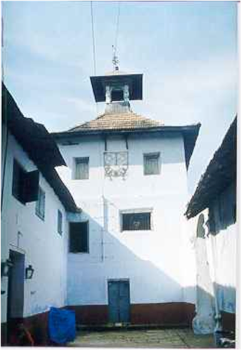
Mid 18th Century Clock Tower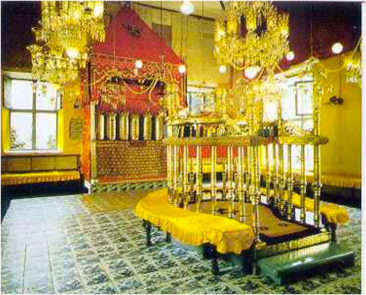
Showing blue tiles brought from Canton, China in 1776
In the heat of the blazing afternoon I returned to the same area (Penny was still suffering from her "Delhi Belly" and was confined to the ship). Synagogue Street is something like the London East End today in that the Jewish names bear superimposed Indian names. Some of the buildings bore the swastika (a Hindu symbol to avert the evil eye) next to a Magen David, placed there by the previous Jewish inhabitant. Incidentally, the shape of the Magen David is also a Hindu charm, and in India it and the swastika are often seen together on buildings and carved in stone on monuments.
I visited the Jewish cemetery, not far from the Paradesi Synagogue, and was shown round by the caretaker's son. There were tombs reputed to date back 1000 years. He showed me where the Black Jews were buried at the side away from the White Jews, even though some Black Jews had reach a social standing as high or higher than most White Jews. From him I learned that a Black Jewish family named Elias still lived in Jewtown, Ernakulam. I prevailed upon my taxi driver to take me there and after searching through the back streets we found Josephai Elias at home at Market Road, with his wife and child named Avital. His home was in simple Indian style. He spoke excellent English and had learned Hebrew from his father. The two synagogues in his district were derelict and only one synagogue remained. Almost all his family and friends had emigrated to Israel. He is allowed to attend the Parades! Synagogue on special occasions to make up a minyan. They offered me tea but as the ship was about to sail I had to make sad farewells and leave.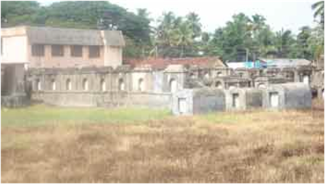
1000 year old Jewish Cemetry at Cochin.
As with so many Jewish communities in Europe and elsewhere the Jewish community of Cochin will soon pass into history.