Higgs Boson
Lecture at U3A Thursday 7th June 2007.
What is the connection between fleas (the ones that bite) and Higgs Boson?
Clue: Big fleas have little fleas upon their backs to bite 'em, and little fleas have lesser fleas and so ad infinitum.
For “fleas” read “particles”…Big particles are made of smaller particles.... and so on, ad infinitum…
In 2008 the the LHC (Large Hadron Collider) at CERN (European Centre for Nuclear Research), near Geneva, will start up. “Large” and “Collider” are self-explanatory but what is a ”Hadron'' ?
A HADRON in particle physics, is a subatomic particle which experiences the nuclear force. They are composed of fermions, called quarks and antiquarks, and of bosons together.
The Large Hadron Collider is a particle accelerator which will probe deeper into matter than ever before. It will ultimately collide beams of protons at an energy of 14 TeV (14 tera volt) . Beams of lead nuclei will also be accelerated, smashing together with a collision energy of 1150 TeV . Te is, of cause, short for Tera…from the Greek word for monster and denotes a million million.
A TeV is a unit of energy used in particle physics. One TeV is about the energy of motion of a -- flying mosquito. What makes the LHC so extraordinary is that it squeezes energy into a space about a million million times smaller than a mosquito.
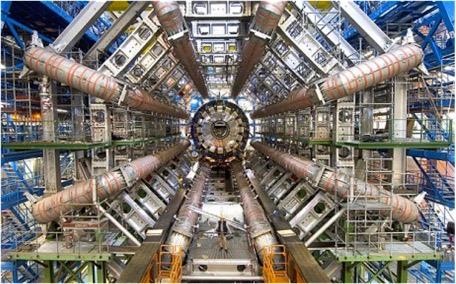
Large Hadron Collider at CERN, Geneva, Switzerland,
Its size can be seen in relation to the man in the lower centre.
The LHC is the next step in a voyage of discovery which began a century ago. Back then, scientists had just discovered all kinds of mysterious rays, X-rays, cathode rays, alpha and beta rays. Where did they come from? Were they all made of the same thing, and if so what?
These questions may soon be answered, giving us a much greater understanding of the Universe.
Along the way, some answers have changed our daily lives, giving us televisions, transistors, medical imaging devices and computers.
And who is, or was, this Mr Higgs and what is, or was, his boson? We will see. Peter Higgs was born in 1929 and was professor at Edinburgh university. He became Professor of theoretical physics at Edinburgh University. He was educated at Cotham Grammar School, Bristol, and King's College London.
Claim to fame: Predicted the Higgs Bosun particle in the 1960s. Further work in classical and quantum fields of research.
Awards: Hughes Medal (Royal Society) 1981, Paul Dirac Medal 1997.He communications mainly by letter, does not have e-mail or television. Quietly spoken.
Higgs is best known for his 1960s proposal of broken symmetry in electroweak theory, explaining the origin of mass of elementary particles in general and of the W and Z bosons in particular. This so-called Higgs mechanism predicts the existence of a new particle, the Higgs boson. Although this particle has not turned up in accelerator experiments so far, the Higgs mechanism is generally accepted as an important ingredient in the Standard Model of particle physics. Higgs conceived of the mechanism in 1964 while walking the Cairngorms, and returned to his lab declaring he had had his "one big idea".
The Higgs Bosun is a small theoretical particle which is the smallest part of the Higgs Field (assuming that it exists!) . It is necessary for a set of rules in physics that are called the ''Standard Model'' but it has not so far been found in an experiment. If the results of the work at CERN cannot show that the Higgs Boson exists, much of our understanding of physics will need to be re-written. It is important in the scientific world because many scientists believe that it is responsible for giving mass to all known particles that have mass.
Because of the elusive search for the Higgs Boson the term ''God Particle'' has been applied to it - but not in the scientific community. In 2011 it was thought that there had been indications that could represent the Higgs Boson particle, but this was thought to be an error.
At the beginning of the 21st century, we face new questions which the LHC is designed to address. Who can tell what new developments the answers may bring?
[Now, as an aside, and before we continue with today’s topic, let us have a word about a problem some of us, including me, have, that while we have an “Interest in Science” yet we rapidly find ourselves drowning in the complexity of it, once it becomes “fundamental” or very advanced.. Does it mean we lose interest in it even if we don’t understand it all? I think not. We can find it interesting even when our fingernails, by which we are holding on, fail and break away and leave us floundering.
There are two organizations that send me on- line weekly summaries of what is happening on the frontiers of science. Even though I do not get much more than a glimmer of what they are getting at, that glimmer is enough to make one excited and interested in the sort of things that science is up to.
If you are interested:
NANOTECHNOLOGY NEWS which you can get on nanotechweb.org and follow it through. Also, the publication SCIENCE published by the American Association for the Advancement of Science, which you will find on www.aaas.org and follow that through.
Good luck and don’t let the detail get you down].
Now, is particle research at CERN useful ?
CERN say that their accelerators and detectors require the leading edge in technology. For this, CERN works in close collaboration with industries, to the benefits of both partners. Related spin-offs, in all kinds of other domains, are now incorporated in our daily lives. Cancer therapy, medical and industrial imaging, radiation processing, electronics, measuring instruments, new manufacturing processes and materials, the World Wide Web, these are just some of the many technologies developed at CERN during research in particle physics.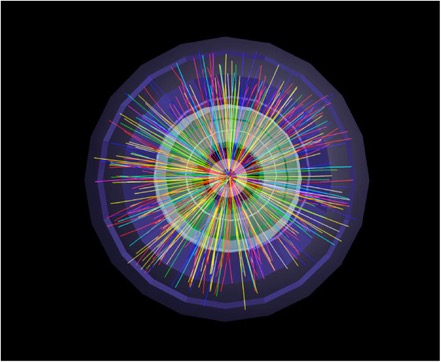
Particle tracks seen by ALICE
Using atom-sized particles of lead, boffins in CERN in Geneva, Switzerland, have been recreating sub-atomic explosions - like the one that may have happened around the time of the big bang.
Above, spectacularly colourful particle tracks from the first stable run of lead ion collisions seen by the
ALICE (A Large Ion Collider Experiment) detector
And now, back to one of the smallest “fleas” of all - The Higgs Boson. Who is this Mr Higgs? What is a Boson?
The word boson was named after Prof Satyendra Nath Bose (1894 - 1974). He was born in Calcutta, India. [Incidentally, the shockingly expensive headphones with the same name Bose are named after a different Indian gentleman. ]
He started his career as a Lecturer in Physics in Calcutta University. In 1924 Bose produced a short article relating to physics, on "Max Planck's Law" and "Light Quantum Hypothesis". He sent the article to Albert Einstein and this little article brought about a great change in the life of Bose. Einstein appreciated it so much that he himself translated it into German and sent it for publication to a famous periodical in Germany - 'Zeitschrift fur Physik'. He also explained at length the significance of the subject matter of the article and the great possibilities the article indicated.
Later, Einstein systematically adapted Bose's approach in his own work. That is why the particular field of Bose's research came to be known as 'Bose-Einstein Statistics'. Later, it came to be known merely as 'Bose Statistics”. At that time Quantum Statistics, a well-known branch of science today, was yet to see the light of day. Bose's theoretical exposition developed this branch. And Quantum Statistics has enabled scientists to solve a number of difficult problems
Now let us show that we are not the only people who have problems with nuclear physics. Rather than try to give my own description of what the fuss is all about, I think it best if I give examples of how others have tried to explain it, in particular to people who are not themselves nuclear physicists.
In 1993 Lord Waldegrave, who was Minister for Science, said that British taxpayers were paying large sums of money to CERN for something very few of them understood. He challenged UK particle physicists to explain, in a simple manner on one side of a sheet of paper ''What is the Higgs Boson and why do we want to find it? '' I can give you two examples of the replies.
The first is called :
A quasi-political Explanation of the Higgs Boson, prepared to assist Lord Waldegrave the Minister for Science. It is by David Miller of University College.
1. The Higgs Mechanism
Imagine a cocktail party of political party workers who are uniformly distributed across the floor of a room all talking to their nearest neighbours. The Prime Minister enters and crosses the room. All the workers in her neighbourhood are strongly attracted to her and cluster round her. As she moves she attracts the people she comes close to, while the ones she has left return to their even spacing. Because of the knot of people always clustered around her she acquires a greater mass than normal, that is, she has more momentum for the same speed of movement across the room. Once moving, she is harder to stop, and once stopped she is harder to get moving again because the clustering process has to be restarted. In three dimensions, and with the complications of relativity, this is the Higgs mechanism. In order to give particles mass, a background field is invented which becomes locally distorted whenever a particle moves through it. The distortion - the clustering of the field around the particle - generates the particle's mass. The idea comes directly from the Physics of Solids. Instead of a field spread throughout all space a solid contains a lattice of positively charged crystal atoms. When an electron moves through the lattice the atoms are attracted to it, causing the electron's effective mass to be as much as 40 times bigger than the mass of a free electron. The postulated Higgs Field in the vacuum is a sort of hypothetical lattice which fills our Universe. We need it because otherwise we cannot explain why the Z and W particles which carry the Weak Interactions are so heavy while the photon which carries Electromagnetic forces has no mass.
(As a bracket, may I clarify that the W and Z particles are elementary particles that mediate, or carry, the fundamental force associated with weak interactions. They were discovered by CERN in early 1980s. They are roughly 100 times as massive as the proton).
Now, let us return to Lord Waldegrave’s cocktail party.
2. The Higgs Boson.
Consider a rumour passing through our room full of the uniformly spread political workers. Those near the door hear of it first and cluster together to get the details, then they turn and move closer to their next neighbours who want to know about it too. A wave of clustering passes through the room. It may spread out to all the corners, or it may form a compact bunch which carries the news along a line of workers from the door to some dignitary at the other side of the room. Since the information is carried by clusters of people, and since it was clustering which gave extra mass to the Prime Minister, then the rumour-carrying clusters also have mass. The Higgs boson is predicted to be just such a clustering in the Higgs field. We will find it much easier to believe that the field exists, and that the mechanism for giving other particles mass is true, if we actually see the Higgs particle itself. Again, there are analogies in the Physics of Solids. A crystal lattice can carry waves of clustering without needing an electron to move and attract the atoms. These waves can behave as if they are particles. They are called phonons, and they too are bosons.
There could be a Higgs mechanism, and a Higgs field throughout our Universe, without there being a Higgs boson.
The next generation of colliders will sort this out.
-oOo-
U P D A T E
On 4th July 2012 CERN announced:
“We observe in our data clear signs of a new particle, at the level of 5 sigma, in the mass region around 126 GeV. The significance is that our understanding of the nature of the universe is about to change''.
This means there is a great probability that the Higgs Boson has been discovered.
To claim a discovery, physicists need to see a statistically significant excess over and above what they expect to see from known physics, and they measure the degree of significance using a quantity called a standard deviation, or sigma.
5 Sigma indicates a 99.99995 percent chance that the result can be reproduced, that it is trustworthy and can survive the test of time. 5 Sigma describes effects where the chance of random occurrence is smaller than a few parts in tens of millions, and is agreed to be enough to claim the discovery of a new particle or phenomenon.
126 GeV means 126 billion electron volts.
An example of simulated data modelled for the CMS (Compact Muon Solenoid) particle detector on the Large Hadron Collider at CERN. Here, following a collision of two protons, a Higgs boson is produced which decays into two jets of hadrons and two electrons. The lines represent the possible paths of particles produced by the proton-proton collision in the detector while the energy these particles deposit is shown in blue.
The next step will be to determine the precise nature of the particle and its significance for our understanding of the universe. Are its properties as expected for the long-sought Higgs boson, the final missing ingredient in the Standard Model? Or is it something more exotic?
The Standard Model describes the fundamental particles from which we, and every visible thing in the universe, are made, and the forces acting between them.
All the matter that we can see, however, appears to be no more than about 4% of the total. A more exotic version of the Higgs particle can be a bridge to our understanding the 96% of the universe we cannot see. 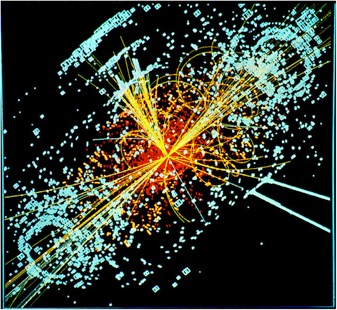
An example of simulated data modelled for the CMS (Compact Muon Solenoid) particle detector on the Large Hadron Collider at CERN. Here, following a collision of two protons, a Higgs boson is produced which decays into two jets of hadrons and two electrons. The lines represent the possible paths of particles produced by the proton-proton collision in the detector while the energy these particles deposit is shown in blue.
- oOo -